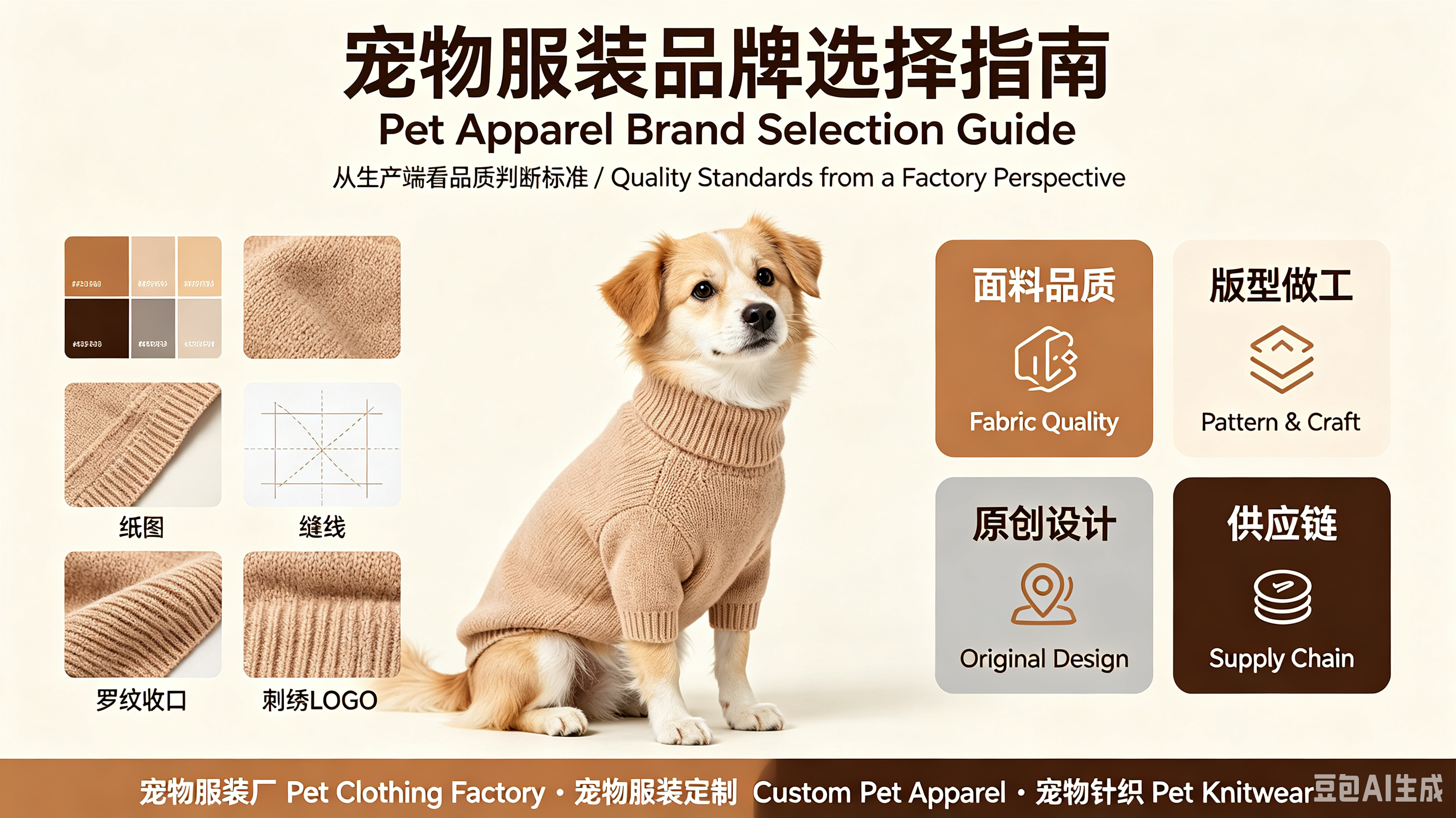
Pet Apparel Brand Selection Guide: Quality Criteria from the Manufacturer's Perspective
Pet Apparel Brand Selection Guide: Quality Criteria from a Manufacturing Perspective The pet apparel market has expanded significantly in recent years, with a rapid increase in brand offerings. This leaves both consumers and retailers with more choices than ever when selecting brands. From a factory production standpoint, this article outlines the core dimensions for evaluating the reliability of pet apparel brands—providing valuable insights for industry product selection and guiding businesses seeking custom pet apparel manufacturing. Special emphasis is placed on knitted pet apparel, which represents the largest segment, offering clear quality standards tailored to this category.
Pet Apparel Brand Selection Guide: Quality Judgment Standards from a Production Perspective The pet apparel market has expanded significantly in recent years, with a rapid increase in the number of brands. As consumers and retailers face more options, this guide outlines core criteria for evaluating brand reliability from a production standpoint. It serves as a reference for industry sourcing and provides a clear framework for assessing pet clothing factories on custom projects—particularly for high-volume knitwear categories.
1. Fabric Quality: The Foundation for Brand Differentiation The core distinction between brands lies in their fabric selection standards. This is especially evident in key categories like pet knit sweaters. Mid-to-high-end pet apparel brands and professional manufacturers typically use core-spun yarns, high-elastic filaments, combed cotton blends, and skin-friendly functional fabrics that deliver consistent softness, elasticity, and breathability. In contrast, budget-focused brands often rely on standard acrylic and polyester materials, resulting in noticeable differences in hand feel and wash durability. In custom pet apparel projects, fabric choice directly determines product positioning and pricing tiers. How to quickly assess fabric quality: Check whether the product specifications clearly list fiber composition and fabric weight. Transparency in these details signals reliability. Premium brands usually set strict controls for shrinkage, color fastness, and pilling resistance—key indicators of brand tier. Professional manufacturers handling custom orders proactively provide fabric test reports and tactile samples, a clear marker of a trustworthy supplier.
Fabric Quality: The Core Differentiator Brand positioning begins with fabric selection standards. This distinction is most evident in key categories like pet knit sweaters. Mid-to-high-end pet apparel brands and professional manufacturers primarily use core-spun yarns, high-stretch filaments, combed cotton blends, and skin-friendly functional fabrics—delivering consistent softness, resilience, and breathability. In contrast, mass-market budget brands typically rely on standard acrylic and polyester bases, often lacking in hand feel and wash durability. In custom pet apparel projects, fabric choice directly defines product positioning and pricing. A quick way to assess quality: check if product specs list fabric composition and gram weight—omission signals lower-tier sourcing. Premium brands enforce strict QC protocols for shrinkage, color fastness, and pilling resistance, offering clear benchmarks for brand differentiation. When handling custom orders, professional factories proactively provide fabric test reports and physical swatches—a hallmark of a trustworthy supplier.
2. Fit and Craftsmanship Reflect Brand Professionalism Pet apparel patterns must be developed independently rather than simply scaled from human clothing designs. Knit pet garments, due to their inherent fabric stretch, require more precise pattern control and demand greater expertise from manufacturers. Brands or factories with proprietary pattern systems deliver superior fit across key areas such as chest ease, neck elasticity, and abdominal curvature. Craftsmanship details also indicate quality commitment: look for reinforced ribbed cuffs and collars, flat-finished internal seams, and premium embroidered logos instead of basic printing. In custom pet apparel services, the ability to make fine-tuned pattern adjustments is a critical performance metric.
Patterns and Craftsmanship Reflect Brand Expertise Pet apparel patterns must be developed independently; they cannot be simply scaled from human clothing designs. The knitwear category demands higher pattern precision due to fabric stretch, testing a factory's technical expertise. Brands with proprietary pattern systems deliver superior fit across chest ease, neckline elasticity, and abdominal curvature tailored to pet body types. Craft details also signal quality: dense ribbing on necklines and cuffs, flatlock or bound inner seams, and exquisite embroidery versus simple printing for logos all demonstrate a brand's commitment to excellence. In custom services, the ability to fine-tune patterns is a key performance indicator.
3. Original Design Capability Drives Differentiation As market competition intensifies due to homogenization, the key to distinguishing brands lies in original design capabilities. Pet apparel manufacturers with in-house design teams offer clearer style identities, exclusive knitwear designs, consistent product updates, and the flexibility to support customized pet clothing needs. In contrast, brands that rely primarily on purchasing existing designs face higher product homogeneity and are more likely to engage in price wars at the retail level.
Original Design Capability Drives Differentiation As market homogenization intensifies, original design capability is the key for brands to stand out. Pet clothing factories with in-house design teams offer clearer style systems, exclusive pet knitwear designs, and consistent update cycles, while also supporting flexible custom apparel needs. Brands relying on ready-made designs face higher product homogeneity and are more prone to price competition in the end market.
4. Supply Chain Stability Drives Long-Term Partnerships For retailers, a brand's production capacity and supply chain capabilities—anchored by its pet apparel manufacturer—are critical to operational stability, particularly during peak seasons for restocking and custom order fulfillment. Brands with in-house factories or deeply integrated production lines offer greater assurance in restocking lead times for bulk knitwear, quality consistency, and custom development. In contrast, brands relying solely on external sourcing face lower certainty in product availability.
Supply Chain Stability Drives Long-Term Partnerships For retailers, a pet apparel brand's in-house production capacity and supply chain capabilities directly impact operational stability. This is critical for peak-season restocking and ensuring efficient delivery of custom orders. Brands with owned factories or tightly integrated production lines offer stronger guarantees for bulk knitwear replenishment cycles, consistent quality, and custom development. Brands relying solely on external sourcing typically face lower supply reliability.
5. Industry Trends in Brand Selection: Observations from factory order volumes show that boutique pet stores, premium e-commerce platforms, and cross-border channels are increasingly demanding higher product quality. Simultaneously, there is rapid growth in direct collaboration with specialized pet apparel manufacturers for custom garment production. Brands and factories possessing in-house fabric R&D capabilities, proprietary pattern systems, and stable pet-knitting capacity are better suited for mid-to-high-end retail scenarios. In the current market environment, a brand's level of specialization has become a core variable in selection decisions.
Industry Trends in Brand Selection: Factory order intake, premium pet boutiques, high-end e-commerce sellers, and cross-border channels continue to raise quality standards for brands. Meanwhile, demand for direct collaboration with professional pet apparel factories for custom clothing is growing rapidly. Brands and factories with in-house fabric R&D, independent pattern systems, and stable knitwear production capacity are best suited for mid-to-high-end retail scenarios. In today's market, brand professionalism has become the key factor in product selection.
Dongguan Kaiyingmei Apparel is a professional pet clothing manufacturer specializing in mid-to-high-end knitted pet products and custom apparel services. The facility features an independent design team, a comprehensive pattern library, and a complete production line. Our core offerings include original product development, sample-making from client-provided images, OEM customization, and small-batch premium orders. We operate exclusively on a wholesale model for mid-to-high-end markets, providing design prototyping and bulk supply services to boutique pet stores, original pet brands, and high-quality cross-border orders. We do not engage in retail sales.
Dongguan Kaiyingmei Apparel is a professional pet clothing manufacturer specializing in mid-to-high-end knitwear and custom apparel. With an in-house design team, extensive pattern library, and full production lines, we focus on original design development, pattern creation from reference images, private label customization, and small-batch premium services. We operate exclusively as a mid-to-high-end wholesaler, providing design sampling and bulk supply for premium pet boutiques, established pet brands, and cross-border high-quality orders. We do not engage in retail sales.