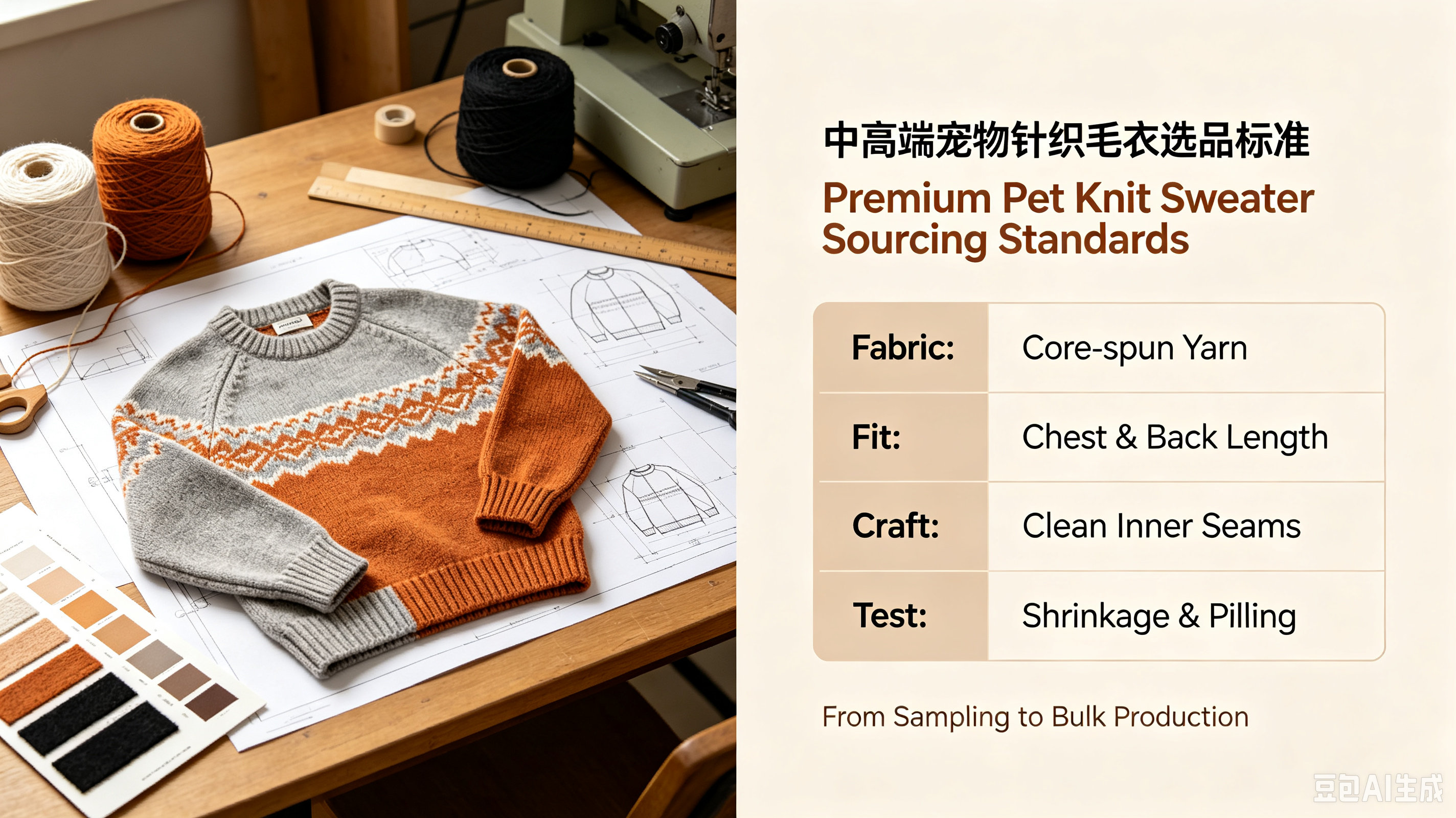
In recent years, the pet apparel industry has accelerated its shift from low-cost volume production to a quality-focused model. Pet owners and retailers now demand greater specificity in fabric safety, fit, and wash durability. Addressing the common challenge of "how to choose a knitted sweater for pets," this article objectively outlines core selection criteria from textile engineering and manufacturing perspectives.
In recent years, the pet apparel industry has shifted from low-cost mass production to quality-driven development. Pet owners and retailers now demand higher standards for fabric safety, fit accuracy, and wash durability. Focusing on the common challenge of selecting pet knit sweaters, this article outlines core sourcing logic based on textile technology and production practices. I. Fabric Composition Determines Core Performance Current pet knit sweaters primarily use four types of materials: 1. Pure Acrylic: Soft and fluffy with low cost, but offers poor breathability, prone to static buildup, and tends to harden or pill after washing. 2. Cotton Blends: Skin-friendly and breathable; small amounts of polyester are often added to improve elasticity. 3. Wool/Cashmere Blends: Excellent warmth and premium feel, ideal for limited-edition holiday collections. For pets with sensitive skin, an inner lining is recommended. 4. High-End Options (Core-Spun or High-Elastic Yarns): Used in mid-to-high-end product lines. These feature a soft, fluffy outer layer with an elastic core that provides structure, ensuring a comfortable fit without being too tight or loose, while offering superior wash and wear resistance. Initial screening should include a tactile test: the fabric must feel smooth against the back of the hand without irritation, rebound quickly when stretched, and have no strong chemical odors before proceeding to further evaluation.
Fabric Composition Drives Core Performance Currently, four primary materials dominate the pet knit sweater market. Acrylic (up to 100%) offers a fluffy feel and low cost but lacks breathability, generates static, and may harden or pill after washing. Cotton blends are skin-friendly and breathable; they typically include a small polyester content for improved resilience. Wool-cashmere blends provide superior warmth and a premium texture, making them ideal for limited-edition holiday styles, though sensitive-skinned pets require lining treatment. Most mid-to-high-end lines now use core-spun yarns or high-stretch filaments: a soft, plush outer layer paired with an elastic inner core delivers a snug yet non-restrictive fit while ensuring durability. For initial screening, perform a tactile test: only products that cause no irritation when rubbed repeatedly on the back of the hand, rebound quickly, and have no pungent odor should advance to further evaluation.
2. Craftsmanship Details Drive Final Pricing The price gap between similar knitted sweaters primarily stems from three key areas: ribbing at the collar and cuffs, seam stitching standards, and interior cleanliness. Premium products typically feature tightly knit ribbing with four-needle six-thread or flat-seam construction to ensure a snug fit without drafts and a smooth interior free of irritation. Loose threads and internal joints are often overlooked quality control blind spots. Flipping the garment inside out to inspect interior neatness is an effective way to identify high-end, premium-quality pieces.
Craftsmanship Details Drive End-Market Pricing The price gap between similar knit sweaters hinges on three factors: ribbing at the neckline and cuffs, seam stitching standards, and interior finish quality. Premium products feature dense ribbing paired with four-needle six-thread or flatlock stitching to ensure a snug fit that blocks wind while remaining smooth against the skin. Loose threads and rough seam joints inside are common QC blind spots. Turning the garment completely inside out to inspect interior neatness is an effective way to identify high-value premium pieces.
III. Practical Tips for Custom Selection and Branding For brand customization and curated product selection, focus on these key areas: 1. Go Beyond Images: Verify technical specifications such as yarn count and fabric weight, and request physical swatches to confirm hand feel. 2. Balance Design Complexity with Wearability: For everyday styles, prioritize clean silhouettes and freedom of movement. 3. Enforce Rigorous Wash Testing: Post-wash shrinkage, color fading, and pilling directly impact customer complaints at the retail level.
Practical Pitfalls to Avoid in Custom Sourcing For brand customization and premium sourcing needs, focus on these key areas: 1) Go beyond product images to verify specifications—confirm yarn count and gram weight, and request hand-feel swatches. 2) Balance design complexity with wearability; for everyday styles, prioritize clean silhouettes and unrestricted movement. 3) Conduct rigorous wash tests, as post-wash shrinkage, fading, and pilling directly impact customer complaint rates in the end market.
As the industry shifts toward higher quality standards, the strength of three core fundamentals—fabric, fit, and craftsmanship—is becoming a key determinant of sourcing success. Dongguan Kaiyingmei Apparel specializes in designing, developing, and producing premium mid-to-high-end pet apparel. With an independent design team and dedicated knit sweater production lines, we focus on original designs, meticulous craftsmanship, and skin-safe fabrics. Our business model is exclusively mid-to-high-end wholesale. We provide design sampling, private label customization, and bulk supply services for premium pet boutiques, original pet brands, and high-quality cross-border orders. We do not engage in retail sales.